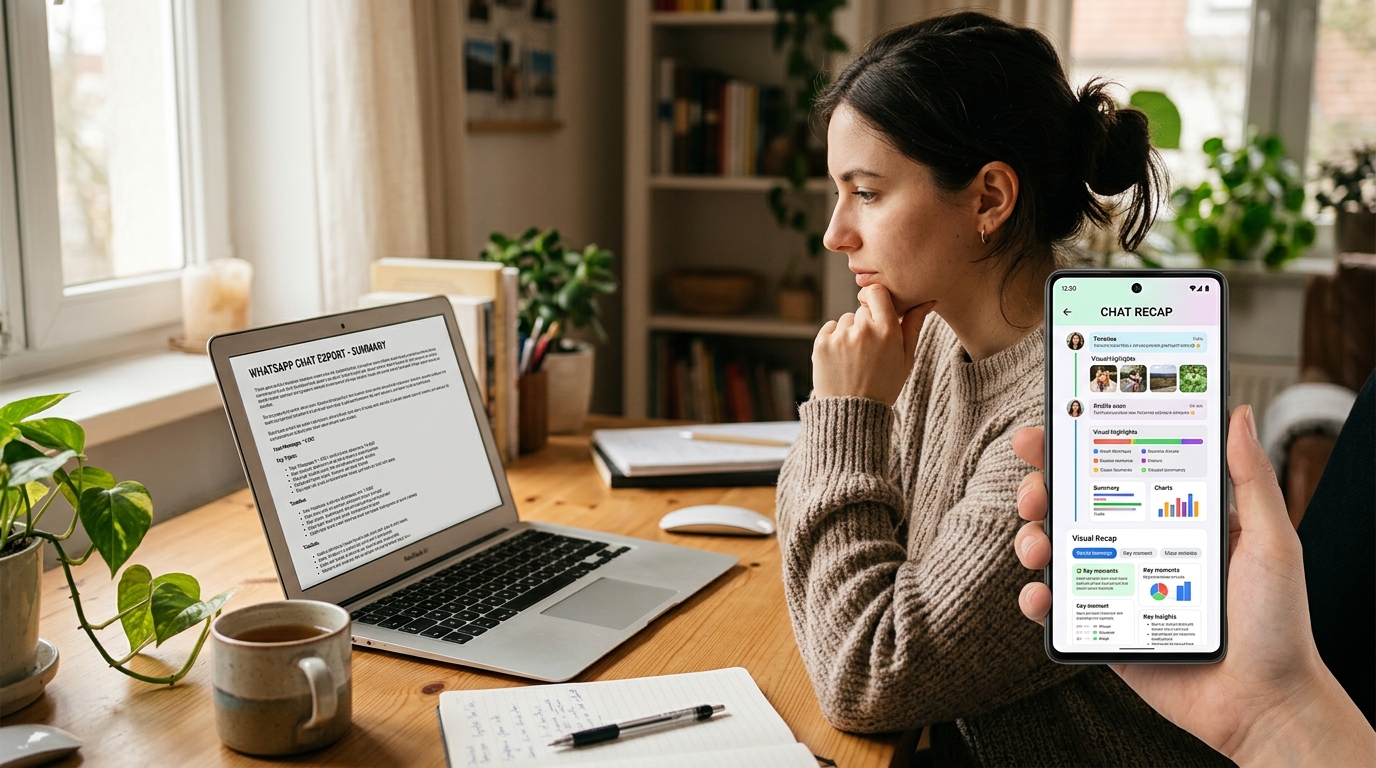
More than 2 billion people use WhatsApp globally, which helps explain why so many users now search for terms like cha t gpt, chat gp t, wchat gpt, chat gpt, and even misspelled variants like chàt gpt when they want quick help making sense of long message threads. The short answer is simple: general chat tools can summarize text, but a recap-focused app is usually better when your goal is to turn exported WhatsApp conversations into readable, structured, and genuinely useful takeaways.
As a technology editor covering digital communication tools and remote work workflows, I have seen the same pattern again and again. People start with a generic assistant because it is familiar. Then they run into the practical issues: messy exports, missing context, character limits, flat summaries, or outputs that feel more like notes than an actual recap of a relationship, project, or group dynamic.
That is where comparison matters. If you are deciding between a broad-purpose assistant and a recap-specific mobile app, the right choice depends less on brand familiarity and more on what you want from the result.
Why do people search for cha t gpt, chat gp t, or wchat gpt for WhatsApp recaps?
Most people are not really searching for a chatbot. They are searching for an outcome: “Please read this long conversation and tell me what mattered.” That is why searches around chat gpt, chatgpt, gpt chat, or conversational AI tools often overlap with interests around message summaries, relationship patterns, meeting follow-ups, and story-style recaps.
In practical terms, users usually want one of four things:
- a quick summary of a long personal chat
- a cleaner overview of a group discussion
- fun insights from a conversation history
- a way to review a WhatsApp conversation without manually rereading everything
That search behavior makes sense. If you have exported your WhatsApp chat history from WhatsApp Messenger or WhatsApp Web, a general tool feels like the obvious first stop. But obvious is not always best.

How does a general chat tool compare with a recap-focused app?
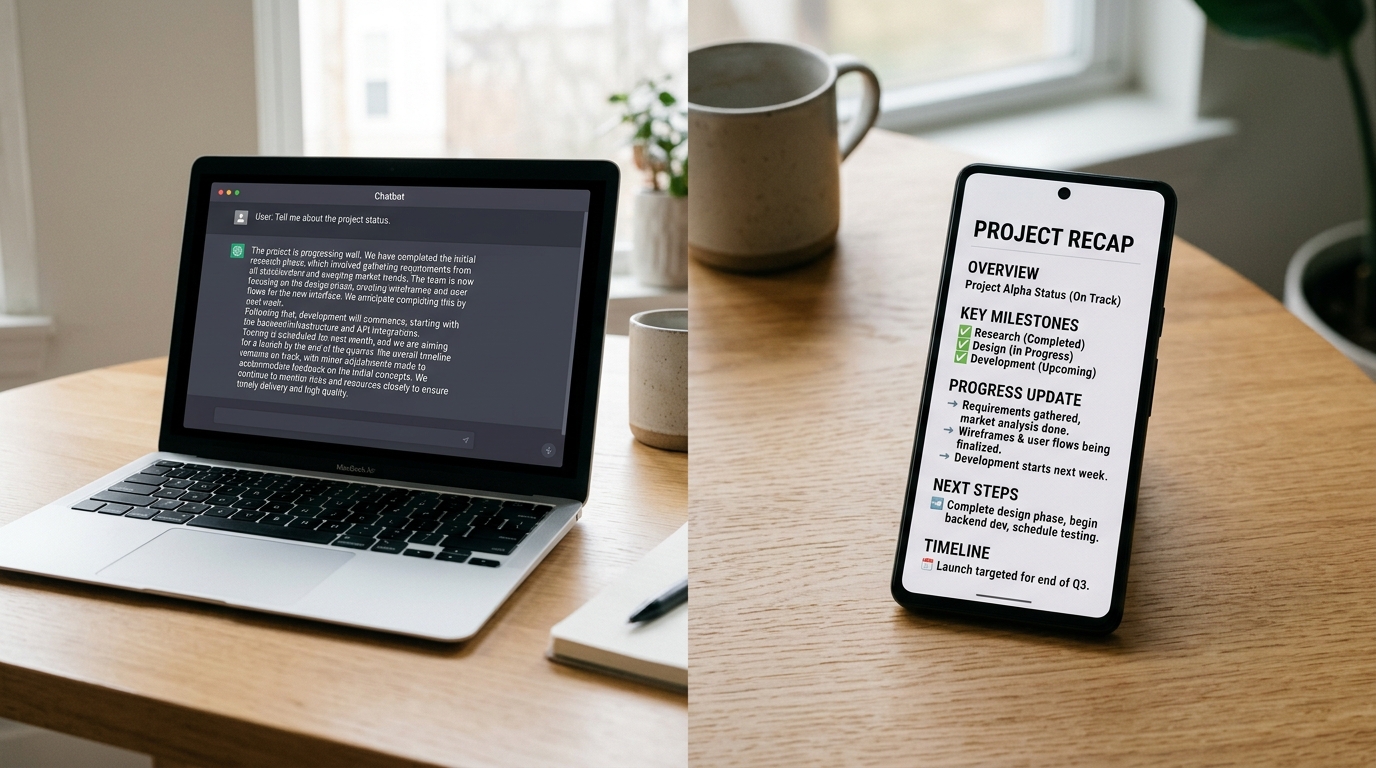
Here is the clearest way to think about it: a general assistant is designed to respond to almost anything, while a recap app is designed to do one job well. That difference shapes the entire experience.
| Approach | Best for | Strengths | Limits |
|---|---|---|---|
| General chat tool | Quick experiments, short pasted text, custom follow-up questions | Flexible, familiar, can rewrite or reframe the summary | Often requires manual cleanup, weaker structure for long exports, results vary a lot |
| Recap-focused app | Exported WhatsApp conversations, recurring recap use, story-style summaries | Built around chat uploads, clearer output, easier for non-technical users | Less open-ended than a blank chat box, narrower use case by design |
If all you need is a rough paragraph from a short exchange, a general tool may be enough. If you want something more readable and structured from a real-world chat export, a specialized app usually has the edge.
That is also the core positioning of Wrapped AI Chat Analysis Recap: it is a mobile app for people who export WhatsApp conversations and want AI-generated summaries and analysis on iPhone or Android without turning the process into a formatting project. If you want entertaining and detailed recap output from uploaded chats, that workflow is designed for exactly that.
What makes chat gpt-style tools less reliable for long WhatsApp exports?
The issue is not that broad chat systems are bad. It is that WhatsApp data is awkward. A raw export usually includes timestamps, repeated names, media notices, system lines, abrupt topic changes, and inside jokes with no explanation. General tools can process that, but they often need help.
Common failure points include:
- Too much cleanup: users spend time deleting noise before they even ask for a summary.
- Overly generic output: the result sounds polished but misses the personality of the conversation.
- Lost chronology: events get flattened, so the “story” of the chat disappears.
- Weak signal detection: recurring themes, conflict patterns, or funny running jokes may be ignored.
In practice reviewing communication products, this is the point where users stop asking “Which chatbot is smarter?” and start asking “Which tool actually fits my file and my goal?” Those are very different questions.
Who benefits most from a dedicated WhatsApp recap app?
The best fit is not everyone, and saying that plainly helps people choose better.
Best for:
- people with long personal or group chats they want summarized fast
- users who prefer uploading an export over pasting chunks manually
- anyone who wants more than bullet points, especially story-like recap output
- remote teams, couples, friends, or families revisiting a long conversation history
Probably not for:
- people who only want to ask one short question about a few messages
- users looking for a general-purpose writing assistant for unrelated tasks
- those who enjoy manually crafting prompts and iterating on every response
That distinction matters because many searches for chat gp t or chàt gpt are really broad discovery searches. The user may not yet realize they are choosing between two different product categories.
How should you choose between chat gp t workflows and a recap app?
I recommend using five decision criteria.
- Input friction: How much work does it take to get from exported chat to usable result?
- Output structure: Do you get a flat summary, or something that reflects the flow of the conversation?
- Repeatability: Will the method still feel manageable after the third or tenth upload?
- Use case fit: Are you summarizing a story-rich conversation, a logistics-heavy group thread, or a business conversation?
- User effort: Does the tool do the organizing, or do you?
If your priority is control, a general assistant wins. If your priority is convenience and chat-specific recap design, a dedicated app wins.
Generic alternatives also differ in an important way: they treat your conversation as text. A recap app treats it as a conversation. That may sound subtle, but it changes the end result considerably.
What are the most common mistakes people make when using chat gpt for WhatsApp summaries?
The first mistake is assuming that any AI chat interface will understand a chat export equally well. It will not. Formatting matters. Chronology matters. Repetition matters.
The second mistake is asking for everything at once. Users paste a huge thread and ask for themes, sentiment, action items, red flags, funniest moments, and a relationship analysis in one go. Even when the result looks coherent, it can become vague.
The third mistake is ignoring the recap style they actually want. Some people want concise notes. Others want playful summaries. Others want detailed analysis of how a group communicates. A general tool can attempt all of these, but a purpose-built app often makes those modes easier to access.
The fourth mistake is choosing based on search familiarity alone. Just because ChatGPT, Gemini, DeepSeek, or other broad tools are well known does not mean they are the simplest option for this specific job.
What questions should you ask before uploading your chat history?
These are the questions I think matter most:
Do I want a summary or a recap?
A summary compresses information. A recap preserves shape, tone, and progression.
Am I analyzing information or revisiting an experience?
For logistics, a simple summary can work. For memorable conversations, story-like outputs are often more satisfying.
How often will I do this?
If this is a recurring habit, a streamlined app experience matters much more.
Do I want entertainment, analysis, or both?
Some users want useful notes. Others want something more fun and reflective.
Where does Wrapped AI Chat Analysis Recap fit in this comparison?
Wrapped AI Chat Analysis Recap sits in the category that many people discover only after trying a generic assistant first. It is not trying to be a universal chat box. It is for users who export a WhatsApp conversation, upload it, and want a recap that feels closer to a readable interpretation than a pasted-text response.
That is especially relevant for people who use WhatsApp Web, WhatsApp Messenger, or move between different messaging habits and want one simple recap flow. The app is aimed at users who want less manual setup and more immediate insight from a conversation archive.
If your goal is to turn uploaded chats into something clearer and more engaging, its recap workflow is built for that specific outcome. And if you are curious how that product category has evolved, the team behind the app is part of Dynapps LTD’s mobile app portfolio.
So which option is better for most people?
For one-off experimentation, a general tool is fine. For exported WhatsApp conversations that you actually want to revisit, compare, or enjoy reading back, a recap-specific app is usually the better choice.
That does not make broad assistants obsolete. They are useful for follow-up questions, custom rewrites, and ad hoc text work. But when the task is narrow and repetitive, the specialized workflow tends to feel more natural.
I have found that users make better decisions when they stop treating every tool in this space as interchangeable. Searches like wchat gpt or chat gp t can start the journey, but they should not decide the workflow. The real decision is whether you want a blank chat box that can try to help, or a tool designed around exported conversations from the beginning.
And that is the useful comparison: not famous name versus famous name, but general-purpose flexibility versus chat-specific clarity.