
Imagine sitting at your laptop, staring at a 40-megabyte text file downloaded straight from your WhatsApp messenger archive. It contains five years of conversations with your best friend—every inside joke, late-night rant, and debated weekend plan. You want to see how your communication has evolved. You open up a standard open ai interface, copy a massive chunk of text, paste it into the prompt window, and hit enter. The system freezes. Then, it spits out a generic, sterile summary that completely misses the emotional nuance, or worse, errors out because the context length is too long. Analyzing personal messaging history requires specialized text segmentation that general AI tools lack; while broad models excel at scientific computing, purpose-built chat analysis applications are required to securely process large messaging exports and extract meaningful relationship insights without breaking context limits.
In practice tracking digital communication tools, this exact scenario is the moment most people realize that brilliant, multi-billion-dollar models aren't actually designed to understand human friendships. I strongly believe we are witnessing a permanent split in the technology ecosystem. On one side, massive platforms are chasing generalized, human-level intelligence for enterprise use. On the other, specialized, single-purpose apps are quietly solving everyday human problems. Wrapped AI Chat Analysis Recap recently hit a significant milestone: processing our 250,000th conversational history. The retention and user feedback data from this milestone confirm my stance—people don't want a generic chatbot to read their texts; they want an architecture structured specifically for private chat analysis.
Why Is Mainstream Open AI Pivoting Away From Personal Context?
To understand why your raw text exports fail in a standard prompt window, you have to look at what the big players are actually building. According to recent industry forecasts, leading AI laboratories are expecting to spend roughly $200 billion through the end of the decade. Crucially, a majority of that massive budget is dedicated to training and running models designed for enterprise and scientific breakthroughs, absorbing projected losses to reach those heights.
They aren't optimizing for your group chat's specific slang. An industry report titled AI as a Scientific Collaborator revealed that major conversational models process millions of weekly messages strictly focused on advanced topics in the hard sciences and mathematics. That sector alone has seen explosive growth recently. With massive global valuations and hundreds of millions of monthly active users, the focus is squarely on coding, logic, and professional research.

When a large-scale artificial intelligence system is busy accelerating biological research or debugging complex code, parsing the messy, fragmented reality of a WhatsApp Web conversation becomes an edge case. These models are trained to be objective and concise, which is the exact opposite of how human beings text. Human conversation is repetitive, emotionally driven, and full of implied context.
What Happens When Specialized Applications Take Over?
This divergence is why our team built Wrapped AI Chat Analysis Recap, and why crossing the quarter-million mark feels so validating. Wrapped AI Chat Analysis Recap is an application that uploads WhatsApp chat history to create fun summaries and detailed relationship analyses using AI. It is built natively for iOS and Android, serving users who want to reflect on their digital connections.
When we look at our retention growth, the user feedback tells a remarkably consistent story. People often try to upload their data to a standard chatbot interface first, fail, and then seek out a dedicated tool. As my colleague İrem Koç explained in a recent post on debunking myths about WhatsApp export summaries, pasting years of messages into generic interfaces destroys the conversational context. The specialized architecture we use maps the emotional arc of the conversation over time, recognizing who talks most, what words are overused, and the shifting tone of the relationship. It treats the data not as a flat database query, but as a human story.
Who Actually Needs Dedicated Chat Recap Tools?
It helps to be specific about who actually benefits from stepping away from generic chatbots. Looking at our recent milestone data, our core users fall into three distinct categories:
- Students and friend groups: People looking to create a fun, nostalgic summary of their group chats for the end of the year or a special occasion.
- Couples: Partners wanting to see their communication trends, such as who initiates conversations more often or how their shared vocabulary has evolved over the years.
- Digital archivists: Individuals who maintain long-standing group chats and want a visually appealing summary of their historical data without manually reading through thousands of texts.
Who is this NOT for? If you are a commercial manager trying to analyze customer service tickets from a WhatsApp Business download for compliance or automated billing, this is not your tool. You need an enterprise CRM integration. Our app is built for personal, organic connection, not corporate auditing.
How Does Infrastructure Dictate Your Summary Quality?
One of the clearest insights from our 250,000-user milestone is that infrastructure matters just as much as the language model itself. In the broader industry, we see a massive transition toward foundational agentic infrastructure for enterprises. But what does that mean for a normal person trying to analyze a GB WhatsApp text export?
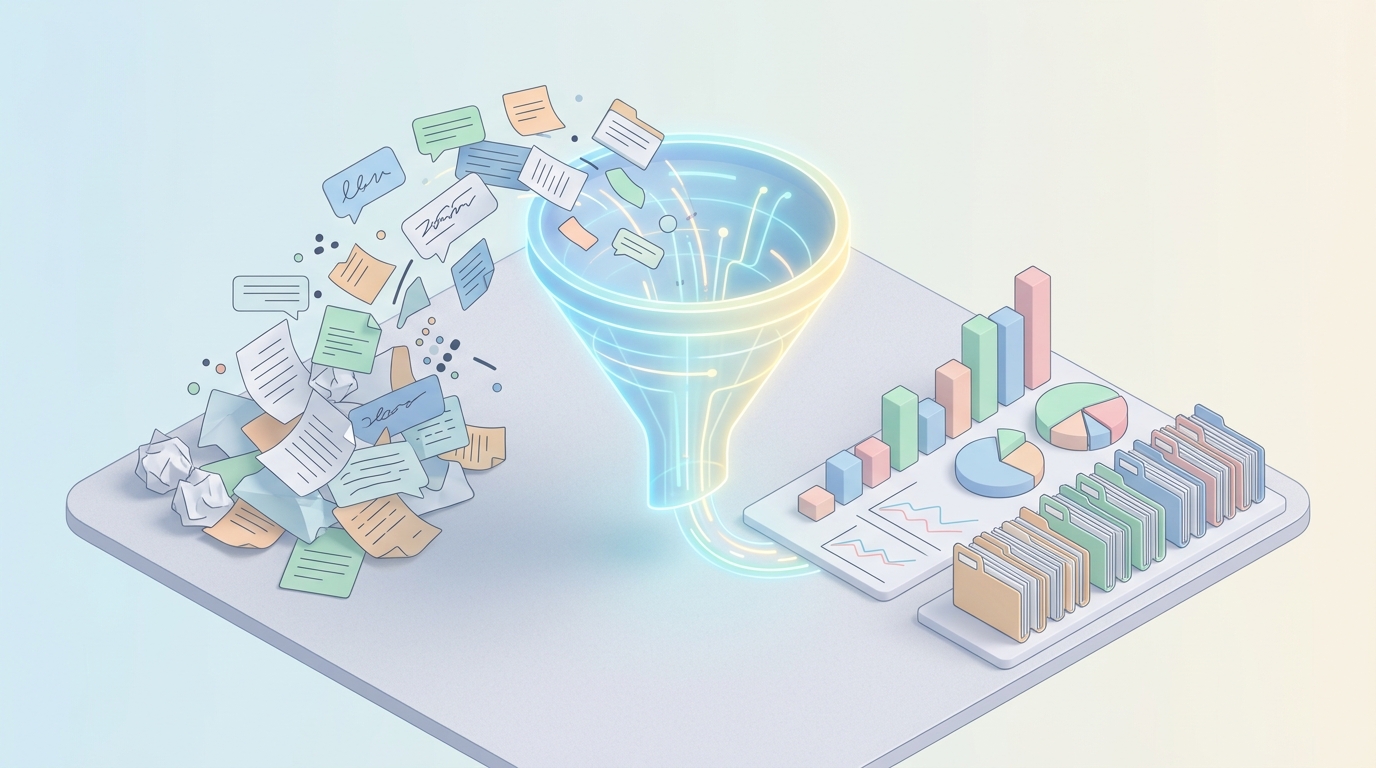
It means that throwing raw text at a wall is a dead practice. Specialized tools pre-process the text locally. When you use a recap app, the application parses the timestamp, the sender, and the message format before the analytical layers ever touch it. The counterargument I often hear is, "Can't I just write a better prompt?" You can certainly try. But as Berk Güneş pointed out when discussing the step-by-step processing of large message exports, no amount of prompt engineering can fix a token-limit crash when you feed it a 50,000-word file. A specialized app segments the data, analyzes it in manageable chunks, and stitches the narrative back together accurately behind the scenes.
How Do You Choose Between General Chatbots and Niche Apps?
If you're deciding how to handle your digital communication archives, you need a basic decision framework based on your end goal. I recommend evaluating three specific criteria:
1. Privacy Policies and Data Handling
Does the platform train its future models on your private messages? General artificial intelligence chat models historically used user inputs for training unless explicitly opted out. Specialized recap apps should have strict, transparent data policies where chats are processed and immediately discarded. If you value privacy, a mobile app company building single-purpose privacy-first tools will often provide a safer environment than a global conversational engine.
2. Formatting Compatibility
A standard chat window hates raw timestamps and system messages (like "Media omitted"). A dedicated app knows exactly how to read exported .txt files from major messaging platforms without requiring you to manually clean the document first.
3. The Final Output Goal
If you want to ask a specific, factual question like, "What date did we agree to meet for coffee last month?", a standard search function in your native messaging app works best. However, if you want a detailed, visually engaging narrative of your communication habits over the last year, Wrapped AI Chat Analysis Recap's feature set is designed precisely for that outcome.
The broader tech ecosystem is moving toward solving massive, global-scale problems. The projected financial investments of mainstream AI leaders are the price of chasing a universal intelligence that can debug quantum computing models. But human relationships aren't math problems. They are continuous, highly contextual, and deeply personal. Hitting the quarter-million mark proves that there is a massive appetite for technology that scales down to the individual level. We don't always need a system that can solve everything; sometimes, we just need a tool that helps us understand the people we talk to every day.